
Scalable protein infrastructure powered by water lentils
Phyto Foods develops a modular cultivation platform based on Lemna — enabling locally deployable, resource-efficient protein production across Europe.
The challenge
Global demand for protein continues to grow structurally while agricultural land, freshwater and fertilizer resources are becoming increasingly constrained.Europe remains highly dependent on imported plant protein sources, particularly soy. The European plant protein ingredient market is estimated at approximately €3.9 billion in 2025 and is projected to approach €5 billion by 2030.At the same time, the European Union imports roughly 19 million tons of plant-based protein products annually to meet demand. These supply chains are highly land-intensive, climate-dependent and geographically concentrated, creating structural vulnerabilities in food production systems.Traditional crop cultivation requires vast land areas and remains exposed to climate variability and supply chain disruptions.
Why water lentils
Water lentils belong to the Lemnaceae family and are among the fastest growing plants on earth.Under favorable conditions they can double their biomass within a very short period of time, making them particularly interesting for controlled biomass production.Several properties make Lemna well suited for controlled cultivation systems:
rapid biomass growth
naturally high protein potential
efficient nutrient uptake from water
compatibility with shallow water cultivation
suitability for indoor environments
Because Lemna grows on the surface of water, it can be cultivated in compact aquatic systems that do not require soil-based agriculture.This opens the possibility of producing protein-rich biomass in highly controlled environments.
Our approach
Phyto Foods focuses on controlled cultivation of water lentils (Lemna), a small aquatic plant known for its exceptionally fast growth rate and high protein potential.Instead of relying on open-field agriculture, our approach is based on controlled environments where the key growth parameters can be monitored and optimized.

Automated water lentil cultivation
Water lentil (Lemna) cultivation is built as a data-driven, automated process. Instead of maximizing biomass alone, we optimize protein yield and steer plant composition through controlled parameters. Continuous monitoring reduces variability and improves predictability.
Controlled, non-seasonal production
The platform operates in fully controlled environments with fixed light and thermal profiles. Output is decoupled from climate, geography and seasonality.


Spatial efficiency
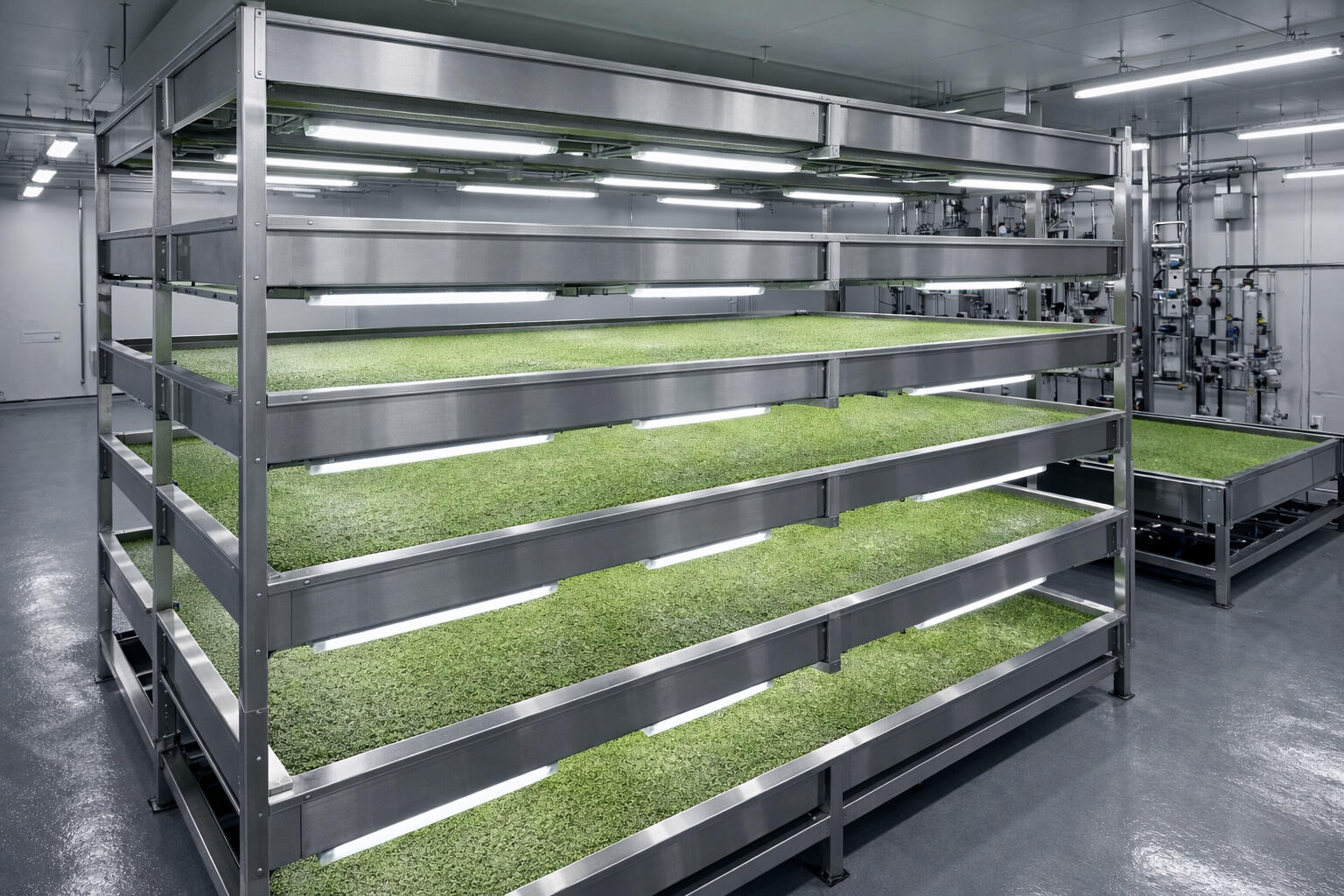
Vertical stacking significantly increases effective cultivation area per square meter compared to traditional agriculture.
Integrated water intelligence
Water flows and nutrient concentrations are actively managed through real-time measurement and dynamic adjustment. The system minimizes losses while stabilizing growth cycles.

Structural cost efficiency
Automation, density and environmental control are designed to drive structurally lower cost per kilogram of protein at scale independent of land constraints.
Replicable architecture
The system consists of identical modular units with fixed operational parameters. Scaling occurs through replication, not redesign.

Technology platform
The Phyto Foods system is designed as a modular cultivation platform that enables controlled protein production from water lentils.Rather than focusing solely on increasing biomass, the platform is engineered to actively steer biomass composition.By dynamically adjusting variables such as nutrient ratios, light intensity profiles and harvest timing, the system can influence key production parameters including:
protein concentration
carbohydrate balance
biomass productivity
nutrient uptake efficiency
This compositional control layer allows cultivation strategies to be optimized depending on the intended downstream application.
System design
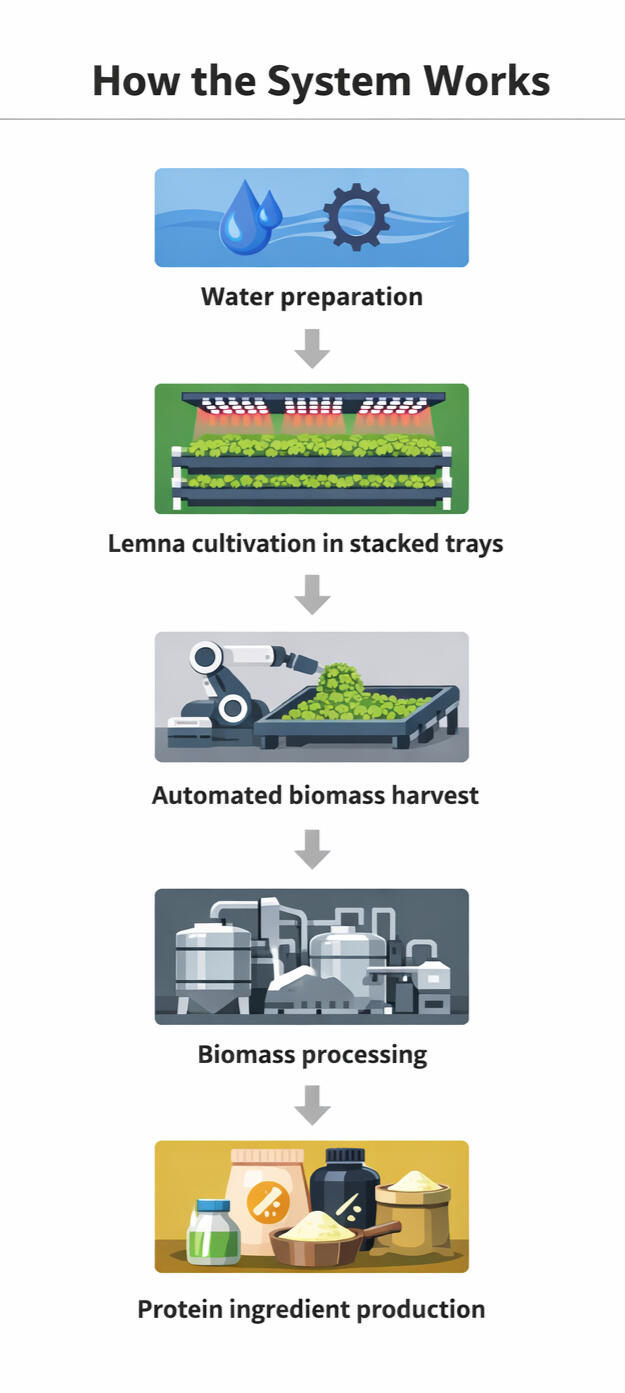
The cultivation platform operates as a stacked indoor system consisting of modular aquatic growth trays.Each module provides a shallow water surface where Lemna colonies grow under controlled environmental conditions.Core system components include:
shallow trays provide a stable water surface for Lemna cultivation
LED lighting supports controlled growth conditions
water management systems maintain optimal nutrient levels
automated harvesting mechanisms remove biomass at controlled intervals
monitoring systems track environmental parameters such as water quality and growth dynamics
Together these elements create a controlled cultivation environment where growth conditions can be continuously observed and adjusted.
Current development
Phyto Foods is currently building its first pilot system to validate the core technical components of the platform, including growth dynamics, water chemistry, automated harvesting and biomass composition steering.Development is conducted in-house through iterative testing and optimization. Parallel efforts include quality profiling and preparation for European Novel Food regulatory pathways, including future EFSA submission.
Future products
The cultivation platform produces protein-rich biomass that can be further processed into ingredients for several downstream industries.Because biomass composition can be influenced during cultivation, the system enables targeted development of different product streams depending on market demand.Potential applications include:
Food and nutrition
protein-rich ingredients for food production
plant-based protein concentrates
functional ingredients for plant-based foods
protein enrichment for meat alternatives and nutrition products
Biotechnology
fermentation feedstock for microbial processes
carbohydrate streams for industrial fermentation
substrates for bio-based materials
Health and personal care
plant-derived functional ingredients for health products
bioactive compounds for nutraceutical applications
natural ingredients for cosmetic formulations

Founded by two brothers
All system design, integration and validation are conducted internally, ensuring tight feedback between engineering decisions and operational performance.
Phyto Foods B.V.
KvK: 98522078
Naarden, The NetherlandsBuilding scalable protein infrastructure based on water lentils.Contact:
[email protected]